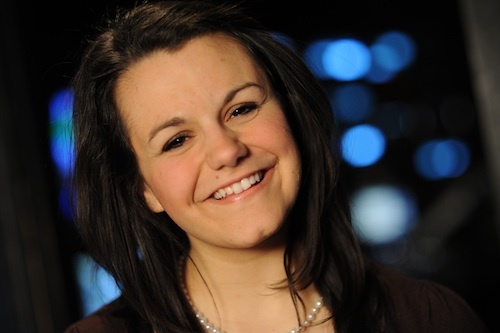
Letters Home: Erica Zucco

Erica Zucco is a researcher for the weekend "Today" show.
She graduated from the Missouri School of Journalism in
2010 with a degree in convergence journalism.
The following letter was submitted March 22, 2012

Hey ONA Mizzou! I’m a relatively recent alum -- I’ve only been out of school since May 2010 -- so my hindsight might not be quite 20/20 yet... but I can share what I've learned so far:

You’re gonna miss this. Everyone says this and I used to roll my eyes, but now I get it. During college you have time, energy and freedom and you’re in an environment driven by possibility and excitement. You can learn what you want to learn, work on what you want to work on and spend as little time sleeping and as much time with friends as you want.
So in terms of journalism, use this time to take chances... and in terms of “life,” enjoy Mizzou, and semi-adulthood, as much as you can. If someone asks you to take a road trip, just say yes (no matter where you’re going). If you’re tired on a Friday night, get over it and go out anyway. Go to games even if you don’t think you have the most school spirit (you will once you graduate). The bottom line is just... say yes. Do it all. Because even though the next few years of life will also be packed with amazing memories and experiences, they’ll be of a different nature, and you want to take advantage of everything you can while at Mizzou.

NPR embraces 'multimedia audio,' adds news-apps team

By Erin Dismeier

Days after The Washington Post reported NPR is running a deficit of $2.6 million, the renowned radio organization announced it was adding a team dedicated to making news applications. Will this help the company get out of its financial slump?

We can only predict, but there may be a chance.

Public-radio listeners are generally better-educated than the average population and are typically middle- to upper-class. That means they're more likely to have devices that can support news apps. Also, around one in 12 listeners donates to his or her local NPR affiliate.  The network's audience may not be huge, but it's an involved bunch that's willing and able to lend support. It will be interesting to see if these listeners keep donating after NPR starts pumping out apps.

It seems radio has been the last news medium to accept tablets and mobile devices. In January, the BBC's Tim Davie told The Guardian he's reluctantly chosen to accept mobile journalism and encourages radio people to generate "creative visual content to attract younger listeners."

So, why has radio been last to welcome technological changes?

Letters Home: Steve Lippo

Steve Lippo is a sports producer at WGN-TV
in Chicago. He graduated from the Missouri
School of Journalism in 2004 with a degree
in broadcast journalism.
The following letter was submitted April 17, 2012

Dear ONA Mizzou,

Run. Run as fast as you can. That's what a lot of people working in this business will tell you. More work, less money. More graduates, less jobs. These are facts, not fairy tales. They are truths all budding journalists must accept before diving in head first. Still think you're ready for this life? Let’s see….
.................................
I can best describe working in journalism as being a contestant on ABC's Wipeout...for the rest of your life.
-You are constantly fighting for everything. Ratings, resources, time, story ideas, exclusives, etc etc etc.
-The show has judges. You will have a news director. Or an editor. They hold all the power. At some point, you will disagree with them. You will probably lose this argument.
-Sometimes you get metaphorically smacked in the face for no apparent reason. Taste it.
-Change can be unexpected and quick. Be prepared for anything in all parts of the daily grind.
-Most of you will never make more than $50k (per year) for your Herculean effort.
-Yet, in the end, nothing is more satisfying than doing your best and finishing strong.
.................................
It's at this point you're thinking one of two things: "What is this guy's obsession with game shows?" OR "what a jaded asshole this guy is!"
-Well, I absolutely LOVE game shows. I would have dominated Legends of the Hidden Temple as a kid. (please tell me somebody in that room has heard of this show...)
-And yes, I am a jaded asshole. And I'm 1000% better of a journalist because of it.

Department of Labor change could regulate press freedom

By Stacey Welsh

Media organizations are fighting back against a U.S. Department of Labor press lock-up policy. The government basically wants to limit access to statistics like unemployment that businesses and financial news organizations would want to use. The labor secretary now wants journalists to work on computers the government supplies.

A"lock-up" is a Department of Labor-named 30-minute window where reporters could have access to economic data before it is made public. A new lock-up policy would require journalists to request press credentials ahead of time to get data from the government office. This means media organizations that already had credentials need to reapply. The department is not clear whether previously approved organizations have a good chance of receiving new credentials. The Reporters Committee for Freedom of the Press also says the government will require journalists entering press lock-up rooms to leave personal items like bags and cellphones outside. Some journalists feel this regulation is unnecessary and too invasive. 

The Washington Examiner reports the changes are in response to nontraditional news organizations not using data for journalistic purposes, but it does not cite an example of this. This policy could slow news reporting of labor statistics while unemployment is high.

Stricter lock-ups could simply be a new routine journalists must accept to gain advance access to data, but the policy also raises red flags. Could this open the door for more regulations?

Letters Home: Samantha Liss

Samantha Liss is a local editor for Patch. She
graduated from the Missouri School of Journalism
in 2010 with a degree in convergence journalism.
The following letter was submitted Jan. 21, 2012

When I stepped into my role as a Patch local editor, I wasn’t overly enthused about living in the suburbs. Looking back a year later, it’s the best decision I could have made.

If you want to cover a community well, you must be physically present. Good reporting means more than dropping in town to catch the weekly meetings, or important events. It’s about being a part of that local community.

Since I live in the town I cover, if something is amiss, chances are, I’ll know first. If the power goes out in town, so does mine. If the fire truck sirens start wailing, I’ll know to get moving. Some of you may have an office to report to but I encourage you to leave that office and put shoe leather to the pavement. The more visible you are in your community the better.

Good reporting means more than just showing up for the work day. Invest in the community. Spend time at local coffee shops, go to the dog park, grab a drink at the local bar. Try to be an active member of the community by engaging with other residents.